
By
Garret Healy, Software Engineer, Jeppesen Inc.
Joshua Foltz, First Officer, Allegiant Air
Abstract:
The author’s developed the following tables as a crew planning tool. These tables demonstrate how strict FAR Part 117 work rules are in relation to allowed duty time when compared to FAR part 121 subpart Q for Flightcrew activated from Short-Call Reserve.
Airlines must schedule efficient Flight Duty Periods and carefully plan when Flight Duty Periods begin as well as how many segments are involved.
In order to schedule efficient pairings the Airlines should consider looking at productive hours (block time) versus non-productive hours (FDP time).
Definitions:
Duty:
Is defined in FAR part 117.
Means any task that a flightcrew member performs as required by the certificate holder, including but not limited to flight duty period, flight duty, pre- and post-flight duties, administrative work, training, deadhead transportation, aircraft positioning on the ground, aircraft loading, and aircraft servicing.
Pre-Flight Duties:
Includes reporting for an assignment, acknowledging flights to be performed while on duty, will be operated in accordance to FAA regulations, including understanding of the expected conditions that will affect the flight(s) to be performed. Inspections of the aircraft for flight readiness, etc.
Flight Duty Period (FDP):
Is defined in FAR part 117.
Means a period that begins when a flightcrew member is required to report for duty with the intention of conducting a flight, a series of flights, or positioning or ferrying flights, and ends when the aircraft is parked after the last flight and there is no intention for further aircraft movement by the same flightcrew member. A flight duty period includes the duties performed by the flightcrew member on behalf of the certificate holder that occur before a flight segment or between flight segments without a required intervening rest period. Examples of tasks that are part of the flight duty period include deadhead transportation, training conducted in an aircraft or flight simulator, and airport/standby reserve, if the above tasks occur before a flight segment or between flight segments without an intervening required rest period.
Flight Time:
Is defined in FAR part 1.
Commences when an aircraft moves under its own power for the purpose of flight and ends when the aircraft comes to rest after landing.
Flightcrew Member (FCM):
Is defined in FAR part 1.
Is a pilot, flight engineer, or flight navigator assigned to duty in an aircraft during flight time.
Reserve Availability Period (RAP):
means a duty period during which a certificate holder requires a flightcrew member on short call reserve to be available to receive an assignment for a flight duty period.
Short-Call Reserve (SCR):
means a period of time in which a flightcrew member is assigned to a reserve availability period.
Assumptions:
Brief time:
The amount of pre-flight duty before the flight departs the gate. Typically ranges between 0:45 to 1:00; generally contained within a CBA; for the purposes of this paper we will use 1:00.
Debrief time:
The amount of post-flight duty after the flight arrives at the gate. Typically ranges between 0:15 to 0:30; generally contained within a CBA; for the purposes of this paper we will use 0:15.
Flight Time Buffer:
The amount of time used to schedule a FCM within the permissible limitations of FAR part 117.11, for the purposes of this paper we will use 0:30.
Minimum Connect Time:
The minimum time from when an aircraft arrives at the gate, to the time when the aircraft moves away from the gate to allow for sufficient to unload/load passengers and baggage, and make any required service needs for the aircraft before departure as well as performance of pre-flight checklists, for the purposes of this paper we will use 0:45.
Permissible Extensions to FDP:
Under FAR 117.19, it is permissible to operate beyond the scheduled limitations in FAR 117.13 by 0:30, extensions up 2:00 may be conducted before departure under certain conditions, for the purposes of this paper we will use 0:30.
Cumulative Flight Time Limitations:
For the purposes of this paper, a FCM will not be exceeding any of the following limitations:
1 Under 117.23, FCM’s are limited to 100 hours in 672 consecutive hours and 1000 hours in 365 calendar days.
2 Under 121 subpart Q, FCM’s are limited to 30 hours in 7 calendar days, 100 hours in a calendar months and 1000 hours in a calendar year.
Cumulative Flight Duty Time Limitations:
For the purposes of this paper, a FCM will not be exceeding any of the following limitations:
1 Under 117.23, FCM’s are limited to 60 hours in 168 consecutive hours and 190 hours in 672 consecutive hours.
2 Under 121 subpart Q, FCM’s are presently not limited by FDP time.
Rest Requirements:
For the purposes of this paper, a FCM will always be in compliance with the following requirements:
1 Under 117.25, FCM’s are required to have been scheduled for and have been given a rest period of no less than 30 hours in the 168 consecutive hours preceding the start of a FDP.
2 Under 121 subpart Q, FCM’s are required to have been scheduled for and have been given a rest period of no less than 24 hours in the 7 calendar days preceding the scheduled completion of any flight subject to this subpart.
Specific regulatory provisions applied:
Daily Flight Time Limitations (FTL):
1 Part 117 has Daily FTL’s governed under 117.11.
- Based upon FDP start time, the limitation is either 8:00 or 9:00 as defined in Table A.
- Evaluated on a leg by leg basis, FCM may not continue a flight if before takeoff it is known that the FTL will be violated.

Table A
2 Part 121 has Daily FTL’s governed under 121.471(a)(4).
- The scheduled limitation is 8:00.
- A FCM may continue the assigned FDP as long as the flight itinerary is the same as what the FCM began with no further constraints (legal to start, legal to finish), else a reevaluation at the point of rescheduling must take place.
Daily FDP Limitations:
1 Part 117 has Daily FTL’s governed under 117.13.
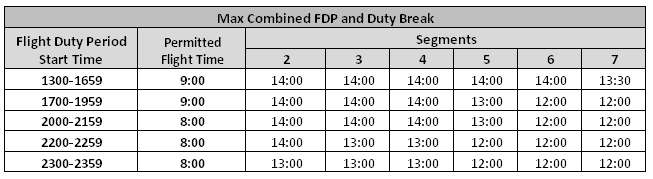
- Based upon FDP start time, the scheduled limitation is defined in Table B.
- Extensions to the assigned FDP are permitted in accordance with 117.19.

Table B
2 Part 121 does not actually have FDP limitations, instead a complicated system based upon 121.471(b) and (c):
- A scheduled flight time in the 24 hours preceding the scheduled completion of a flight segment.
- A required rest period in the 24 hours preceding the actual expected completion of a flight segment. The may be reduced due to operational contingencies before takeoff. Reserve has consistently interpreted by the FAA as not rest.
- A compensatory rest period will be required following the release of a duty period that is preceded by a reduced rest period, this will effectively limit the duty period to a maximum of 16 or 15 hours dependent upon the scheduled flight time in the 24 hour period, and the compensatory rest period must commence within 24 hours of the start of the reduced rest period.

117.21 Reserve status.
(a) Unless specifically designated as airport/standby or short-call reserve by the certificate holder, all reserve is considered long-call reserve.
(b) Any reserve that meets the definition of airport/standby reserve must be designated as airport/standby reserve. For airport/standby reserve, all time spent in a reserve status is part of the flightcrew member’s flight duty period.
(c) For short call reserve,
(1) The reserve availability period may not exceed 14 hours.
(2) For a flightcrew member who has completed a reserve availability period, no certificate holder may schedule and no flightcrew member may accept an assignment of a reserve availability period unless the flightcrew member receives the required rest in § 117.25(e).
(3) For an unaugmented operation, the total number of hours a flightcrew member may spend in a flight duty period and a reserve availability period may not exceed the lesser of the maximum applicable flight duty period in Table B of this part plus 4 hours, or 16 hours, as measured from the beginning of the reserve availability period.
Under FAR 117, the FCM must be scheduled to end the FDP under the more restrictive of the RAP / FDP Limit, or Scheduled FDP limit. In the depiction above, the FDP must end by 18:00.
Extensions under 117.19 must be applied once the FDP is delayed and is expected to end after 18:00.
Nature of Short-Call Reserve:
Unlike Airport Standby, where a FCM is actually on FDP, Short Call FCM’s are not at the Airport.
Unlike Long Call Reserve, a FCM is expected to report for the FDP without an intervening rest period.
Since the FCM may need to travel to the location where the FDP will start most airlines will have a minimum amount of time to allow for the ‘call out’.
The amount of time from the start of the short-call reserve until the report for the FDP is known as RAP, Reserve Availability Period, it includes the ‘call out time’, and may not exceed 14 hours.
Objective comparisons of specific regulatory provisions:

FAR 121 Subpart Q
Starting with the Basic Scheduled Limitations.
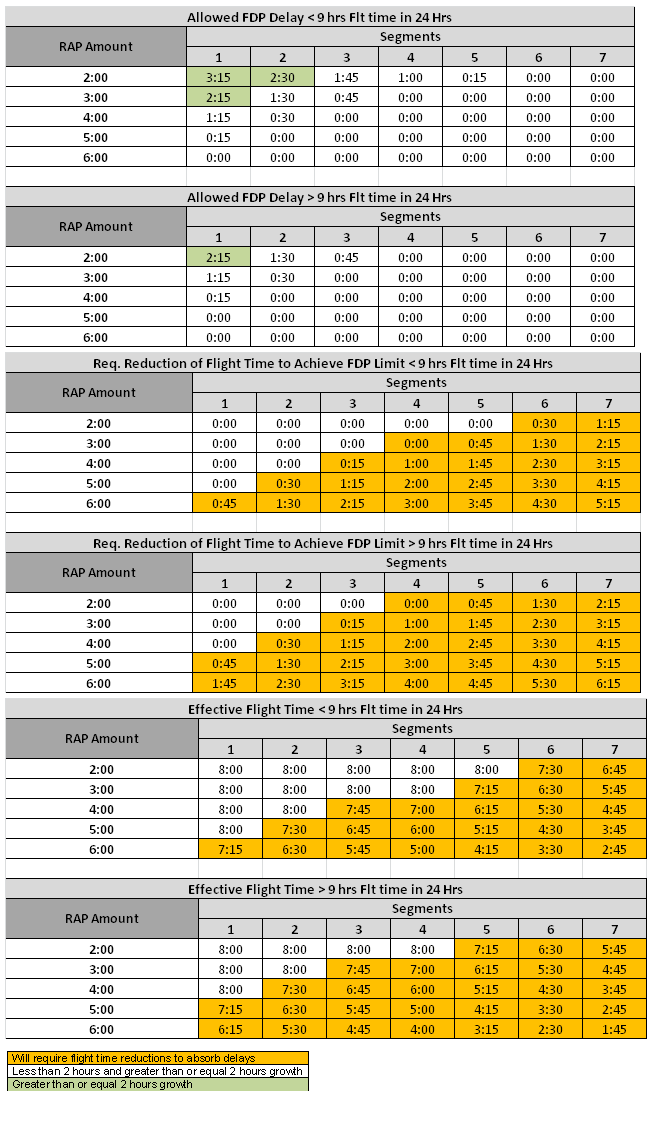
Applied to the duration of the RAP, the Combined RAP + DUTY limits are derived

(Max Duty Time – Max Extension) – ((Max Flight Time – Flt buffer) + Brief + Debrief + (Segments – 1) * Turn) = Allowed Flight Duty Period delay
Relative Efficiency of the FDP
100 * (Max Flight Time)/((max duty time – debrief) + Permitted Pairing Growth)

FAR 117
Starting with the Basic Scheduled Limitations

Applied to the duration of the RAP, the Combined RAP + FDP limits are derived.

This yields the Max Scheduled FDP assigned During the RAP.

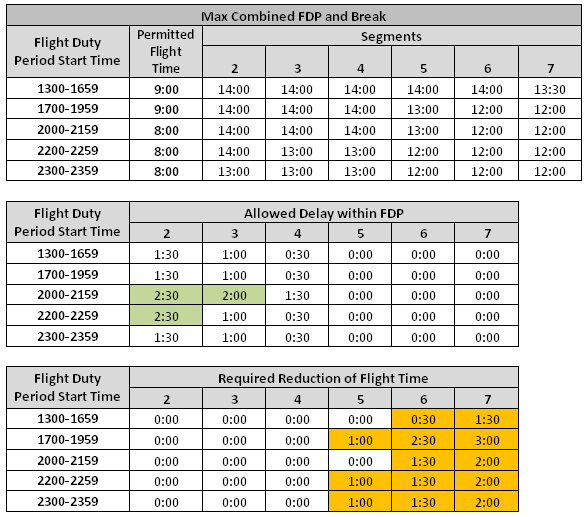
(Max Skd FDP + Max Extension) – ((Max Flight Time – FT Buffer) + Brief + (Segments – 1) * Turn) = Allowed Flight Duty Period delay

(Max Skd FDP + Max Extension) – ((Max Flight Time) + Brief + (Segments – 1) * Turn) = Required Reduction of Flight Time

Relative FDP Efficiency
100 * (Max Flight Time- Required reduction of Flight Time)/(max skd FDP + Permitted Pairing Growth)

Conclusions:
Allowed FDP Delay:
Under both FAR 117 and FAR 121 subpart Q, the Allowed FDP Delay diminishes with an increased amount of time from the start of the RAP to the Report of the FDP. The same can also be said concerning the Allowed FDP Delay with respect to an increase in the number of scheduled flight segments.
FAR 117 also has a Diurnal component, with the highest Allowed FDP Delay values for FDP starts 07:00 and 12:59.
Average Flight Time per segment:
Average Flight Time per segment, predictably diminished with an increase in the number of flight segments, the same can also be said for increased amount of time from the start of the RAP to the Report of the FDP.
Given these facts, it seems that it would impractical to apply RAP FDP to FDP’s with more than 4 segments.
Efficiency:
With respect to efficiency, FAR 117 exhibited better efficiency than FAR 121 subpart Q for a short amount of time from the start of the RAP to the Report of the FDP equal to 2:00, 81.85 percent to 79.56, however, with increasing amount of time from the start of the RAP to the Report of the FDP above 2:00, FAR 121 subpart Q out performed FAR 117.
We did examine the application of 2:00 extensions, and FAR 117, performed better in efficiency, Average Flight Time per Segment, and Allowed FDP Delay.
Recommendations:
FAR 117 Short-Call Reserve is best applied within the first 3 hours of the RAP, and is best applied to FDP’s with less than 5 flight segments. When Short Call Reserve is applied after 3 to 6 hours of the RAP, less than 3 or 4 flight segments seems to be the most practical.
With 7 hours up to 9 hours, very limited situations will allow for its use, however it is still feasible. Beyond 9 hours, seems that it is not very practical, a FCM may be released into a Rest Period and then assigned directly to a FDP.





 Understanding FAR 117