How maximum Flight Duty Periods and maximum Flight Times will affect Airlines FAR 121 subpart Q versus FAR 117 – Activated Short-Call Reserve.


By

Garret Healy, Software Engineer, Jeppesen Inc.

Joshua Foltz, First Officer, Allegiant Air

Abstract:

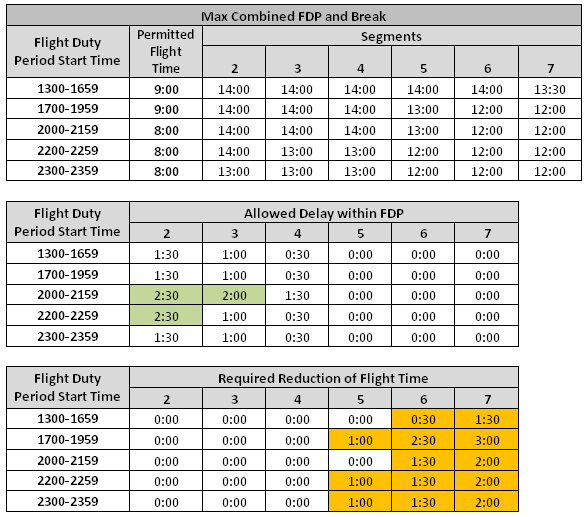
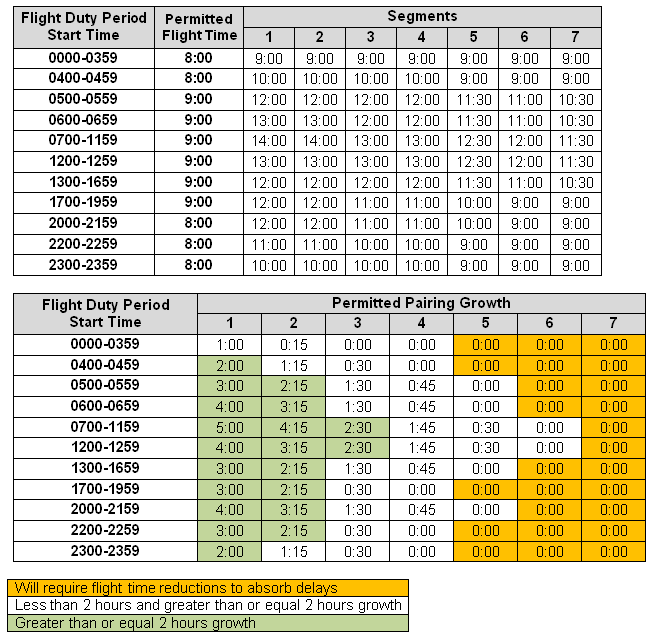
The author’s developed the following tables as a crew planning tool. These tables demonstrate how strict FAR Part 117 work rules are in relation to allowed duty time when compared to FAR part 121 subpart Q for Flightcrew activated from Short-Call Reserve.

Airlines must schedule efficient Flight Duty Periods and carefully plan when Flight Duty Periods begin as well as how many segments are involved.

In order to schedule efficient pairings the Airlines should consider looking at productive hours (block time) versus non-productive hours (FDP time).


Definitions:

Duty:

Is defined in FAR part 117.

Means any task that a flightcrew member performs as required by the certificate holder, including but not limited to flight duty period, flight duty, pre- and post-flight duties, administrative work, training, deadhead transportation, aircraft positioning on the ground, aircraft loading, and aircraft servicing.

Pre-Flight Duties:

Includes reporting for an assignment, acknowledging flights to be performed while on duty, will be operated in accordance to FAA regulations, including understanding of the expected conditions that will affect the flight(s) to be performed. Inspections of the aircraft for flight readiness, etc.

Flight Duty Period (FDP):

Is defined in FAR part 117.

Means a period that begins when a flightcrew member is required to report for duty with the intention of conducting a flight, a series of flights, or positioning or ferrying flights, and ends when the aircraft is parked after the last flight and there is no intention for further aircraft movement by the same flightcrew member. A flight duty period includes the duties performed by the flightcrew member on behalf of the certificate holder that occur before a flight segment or between flight segments without a required intervening rest period. Examples of tasks that are part of the flight duty period include deadhead transportation, training conducted in an aircraft or flight simulator, and airport/standby reserve, if the above tasks occur before a flight segment or between flight segments without an intervening required rest period.

Flight Time:

Is defined in FAR part 1.

Commences when an aircraft moves under its own power for the purpose of flight and ends when the aircraft comes to rest after landing.

Flightcrew Member (FCM):

Is defined in FAR part 1.

Is a pilot, flight engineer, or flight navigator assigned to duty in an aircraft during flight time.

Reserve Availability Period (RAP):

means a duty period during which a certificate holder requires a flightcrew member on short call reserve to be available to receive an assignment for a flight duty period.

Short-Call Reserve (SCR):

means a period of time in which a flightcrew member is assigned to a reserve availability period.


Assumptions:

Brief time:

The amount of pre-flight duty before the flight departs the gate. Typically ranges between 0:45 to 1:00; generally contained within a CBA; for the purposes of this paper we will use 1:00.

Debrief time:

The amount of post-flight duty after the flight arrives at the gate. Typically ranges between 0:15 to 0:30; generally contained within a CBA; for the purposes of this paper we will use 0:15.

Flight Time Buffer:

The amount of time used to schedule a FCM within the permissible limitations of FAR part 117.11, for the purposes of this paper we will use 0:30.

Minimum Connect Time:

The minimum time from when an aircraft arrives at the gate, to the time when the aircraft moves away from the gate to allow for sufficient to unload/load passengers and baggage, and make any required service needs for the aircraft before departure as well as performance of pre-flight checklists, for the purposes of this paper we will use 0:45.

Permissible Extensions to FDP:

Under FAR 117.19, it is permissible to operate beyond the scheduled limitations in FAR 117.13 by 0:30, extensions up 2:00 may be conducted before departure under certain conditions, for the purposes of this paper we will use 0:30.

Cumulative Flight Time Limitations:

For the purposes of this paper, a FCM will not be exceeding any of the following limitations:

1        Under 117.23, FCM’s are limited to 100 hours in 672 consecutive hours and 1000 hours in 365 calendar days.

2        Under 121 subpart Q, FCM’s are limited to 30 hours in 7 calendar days, 100 hours in a calendar months and 1000 hours in a calendar year.

Cumulative Flight Duty Time Limitations:

For the purposes of this paper, a FCM will not be exceeding any of the following limitations:

1        Under 117.23, FCM’s are limited to 60 hours in 168 consecutive hours and 190 hours in 672 consecutive hours.

2        Under 121 subpart Q, FCM’s are presently not limited by FDP time.

Rest Requirements:

For the purposes of this paper, a FCM will always be in compliance with the following requirements:

1        Under 117.25, FCM’s are required to have been scheduled for and have been given a rest period of no less than 30 hours in the 168 consecutive hours preceding the start of a FDP.

2        Under 121 subpart Q, FCM’s are required to have been scheduled for and have been given a rest period of no less than 24 hours in the 7 calendar days preceding the scheduled completion of any flight subject to this subpart.


Specific regulatory provisions applied:

Daily Flight Time Limitations (FTL):

1        Part 117 has Daily FTL’s governed under 117.11.

  1. Based upon FDP start time, the limitation is either 8:00 or 9:00 as defined in Table A.
  2. Evaluated on a leg by leg basis, FCM may not continue a flight if before takeoff it is known that the FTL will be violated.

 table A

Table A


      2        Part 121 has Daily FTL’s governed under 121.471(a)(4).

  • The scheduled limitation is 8:00.
  • A FCM may continue the assigned FDP as long as the flight itinerary is the same as what the FCM began with no further constraints (legal to start, legal to finish), else a reevaluation at the point of rescheduling must take place.


Daily FDP Limitations:

1        Part 117 has Daily FTL’s governed under 117.13.

  • Based upon FDP start time, the scheduled limitation is defined in Table B.
  • Extensions to the assigned FDP are permitted in accordance with 117.19.

 table b

Table B


      2        Part 121 does not actually have FDP limitations, instead a complicated system based upon 121.471(b) and (c):

  1. A scheduled flight time in the 24 hours preceding the scheduled completion of a flight segment.
  2. A required rest period in the 24 hours preceding the actual expected completion of a flight segment. The may be reduced due to operational contingencies before takeoff. Reserve has consistently interpreted by the FAA as not rest.
  3. A compensatory rest period will be required following the release of a duty period that is preceded by a reduced rest period, this will effectively limit the duty period to a maximum of 16 or 15 hours dependent upon the scheduled flight time in the 24 hour period, and the compensatory rest period must commence within 24 hours of the start of the reduced rest period.

121.471(a)(b)

117.21  Reserve status.

(a)       Unless specifically designated as airport/standby or short-call reserve by the certificate holder, all reserve is considered long-call reserve.

(b)       Any reserve that meets the definition of airport/standby reserve must be designated as airport/standby reserve. For airport/standby reserve, all time spent in a reserve status is part of the flightcrew member’s flight duty period.

(c)       For short call reserve,

(1)           The reserve availability period may not exceed 14 hours.

(2)           For a flightcrew member who has completed a reserve availability period, no certificate holder may schedule and no flightcrew member may accept an assignment of a reserve availability period unless the flightcrew member receives the required rest in § 117.25(e).

(3)           For an unaugmented operation, the total number of hours a flightcrew member may spend in a flight duty period and a reserve availability period may not exceed the lesser of the maximum applicable flight duty period in Table B of this part plus 4 hours, or 16 hours, as measured from the beginning of the reserve availability period.

Under FAR 117, the FCM must be scheduled to end the FDP under the more restrictive of the RAP / FDP Limit, or Scheduled FDP limit. In the depiction above, the FDP must end by 18:00.

Extensions under 117.19 must be applied once the FDP is delayed and is expected to end after 18:00.


Nature of Short-Call Reserve:

Unlike Airport Standby, where a FCM is actually on FDP, Short Call FCM’s are not at the Airport.

Unlike Long Call Reserve, a FCM is expected to report for the FDP without an intervening rest period.

Since the FCM may need to travel to the location where the FDP will start most airlines will have a minimum amount of time to allow for the ‘call out’.

The amount of time from the start of the short-call reserve until the report for the FDP is known as RAP, Reserve Availability Period, it includes the ‘call out time’, and may not exceed 14 hours.

Objective comparisons of specific regulatory provisions:

rsv1

FAR 121 Subpart Q

Starting with the Basic Scheduled Limitations.

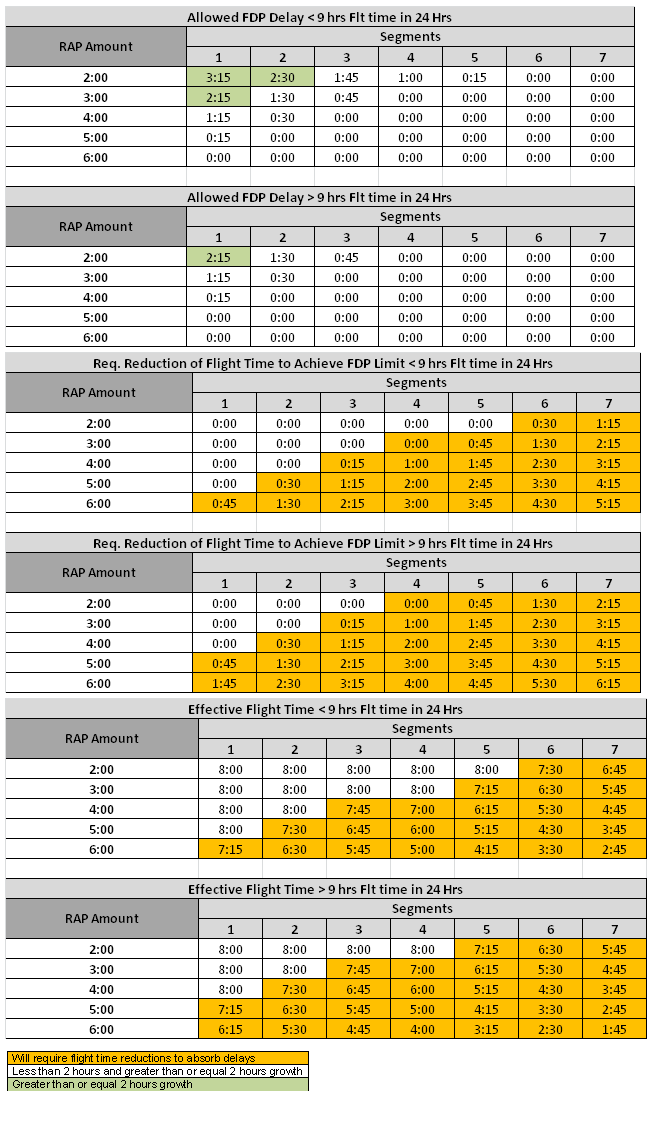
Applied to the duration of the RAP, the Combined RAP + DUTY limits are derived

rsv2

(Max Duty Time – Max Extension) – ((Max Flight Time – Flt buffer) + Brief + Debrief + (Segments – 1) * Turn) = Allowed Flight Duty Period delay
rsv3

Relative Efficiency of the FDP

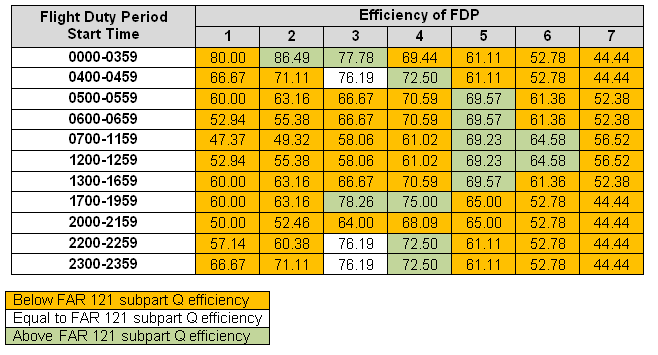
100 * (Max Flight Time)/((max duty time – debrief) + Permitted Pairing Growth)

rsv4

FAR 117

Starting with the Basic Scheduled Limitations

rsv5

Applied to the duration of the RAP, the Combined RAP + FDP limits are derived.

rsv6

This yields the Max Scheduled FDP assigned During the RAP.

rsv7

(Max Skd FDP + Max Extension) – ((Max Flight Time – FT Buffer) + Brief + (Segments – 1) * Turn) = Allowed Flight Duty Period delay

rsv10

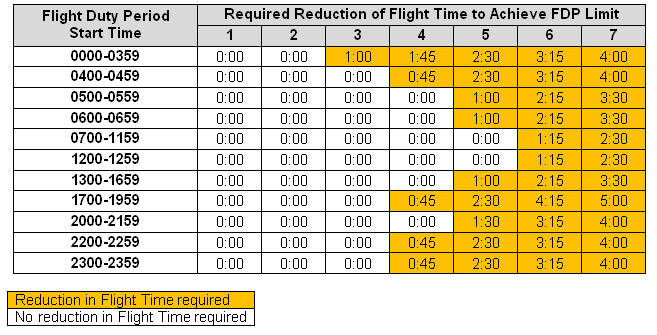
(Max Skd FDP + Max Extension) – ((Max Flight Time) + Brief + (Segments – 1) * Turn) = Required Reduction of Flight Time

rsv8

Relative FDP Efficiency

100 * (Max Flight Time- Required reduction of Flight Time)/(max skd FDP + Permitted Pairing Growth)

rsv9

Conclusions:

Allowed FDP Delay:

Under both FAR 117 and FAR 121 subpart Q, the Allowed FDP Delay diminishes with an increased amount of time from the start of the RAP to the Report of the FDP. The same can also be said concerning the Allowed FDP Delay with respect to an increase in the number of scheduled flight segments.

FAR 117 also has a Diurnal component, with the highest Allowed FDP Delay values for FDP starts 07:00 and 12:59.

Average Flight Time per segment:

Average Flight Time per segment, predictably diminished with an increase in the number of flight segments, the same can also be said for increased amount of time from the start of the RAP to the Report of the FDP.

Given these facts, it seems that it would impractical to apply RAP FDP to FDP’s with more than 4 segments.

Efficiency:

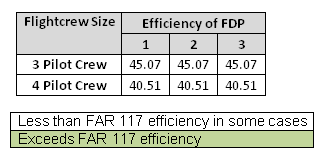
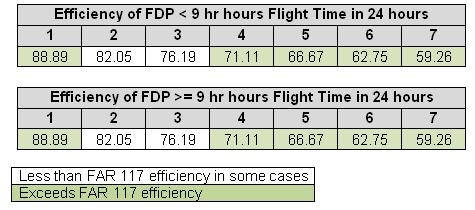
With respect to efficiency, FAR 117 exhibited better efficiency than FAR 121 subpart Q for a short amount of time from the start of the RAP to the Report of the FDP equal to 2:00, 81.85 percent to 79.56, however, with increasing amount of time from the start of the RAP to the Report of the FDP above 2:00, FAR 121 subpart Q out performed FAR 117.

We did examine the application of 2:00 extensions, and FAR 117, performed better in efficiency, Average Flight Time per Segment, and Allowed FDP Delay.


Recommendations:

FAR 117 Short-Call Reserve is best applied within the first 3 hours of the RAP, and is best applied to FDP’s with less than 5 flight segments. When Short Call Reserve is applied after 3 to 6 hours of the RAP, less than 3 or 4 flight segments seems to be the most practical.

With 7 hours up to 9 hours, very limited situations will allow for its use, however it is still feasible. Beyond 9 hours, seems that it is not very practical, a FCM may be released into a Rest Period and then assigned directly to a FDP.

How maximum Flight Duty Periods and maximum Flight Times will affect Airlines FAR 121 subpart Q versus FAR 117 – Split Duty


By

Garret Healy, Software Engineer, Jeppesen Inc.

Joshua Foltz, First Officer, Allegiant Air

Abstract:

The author’s developed the following tables as a crew planning tool. These tables demonstrate how strict FAR Part 117 work rules are in relation to allowed duty time when compared to FAR part 121 subpart Q.

Airlines must schedule efficient Flight Duty Periods and carefully plan when Flight Duty Periods begin as well as how many segments are involved.

In order to schedule efficient pairings the Airlines should consider looking at productive hours (block time) versus non-productive hours (FDP time).

Split duties have been used in the industry under many different names, High-Speed Over Night, Continuous Duty Over Night, Night Turn, Stand-up Overnight, etc. These operations all have the same characteristics, relatively low, flight time and duty time with a duty break of 3 to 6 hours.

Most split duty operations have been utilizing regional jets, where the turn time is smaller.

Until FAR 117 was created, carriers had constraints for split duties mostly within CBA’s.

Definitions:

Duty:

Is defined in FAR part 117.

Means any task that a flightcrew member performs as required by the certificate holder, including but not limited to flight duty period, flight duty, pre- and post-flight duties, administrative work, training, deadhead transportation, aircraft positioning on the ground, aircraft loading, and aircraft servicing.

Pre-Flight Duties:

Includes reporting for an assignment, acknowledging flights to be performed while on duty, will be operated in accordance to FAA regulations, including understanding of the expected conditions that will affect the flight(s) to be performed. Inspections of the aircraft for flight readiness, etc.

Flight Duty Period (FDP):

Is defined in FAR part 117.

Means a period that begins when a flightcrew member is required to report for duty with the intention of conducting a flight, a series of flights, or positioning or ferrying flights, and ends when the aircraft is parked after the last flight and there is no intention for further aircraft movement by the same flightcrew member. A flight duty period includes the duties performed by the flightcrew member on behalf of the certificate holder that occur before a flight segment or between flight segments without a required intervening rest period. Examples of tasks that are part of the flight duty period include deadhead transportation, training conducted in an aircraft or flight simulator, and airport/standby reserve, if the above tasks occur before a flight segment or between flight segments without an intervening required rest period.

Flight Time:

Is defined in FAR part 1.

Commences when an aircraft moves under its own power for the purpose of flight and ends when the aircraft comes to rest after landing.

Flightcrew Member (FCM):

Is defined in FAR part 1.

Is a pilot, flight engineer, or flight navigator assigned to duty in an aircraft during flight time.

Duty Break:

Must meet the following criteria:

  1. Is scheduled before the start of the FDP.
  2. Is at least 3 hours.
  3. Is not provided until after the first segment In the FDP has been completed.
  4. Is provided between 22:00 and 05:00 local time.
  5. Is measured from the time that the flightcrew member reaches the suitable accommodation.
  6. Duty breaks cannot be reducible from scheduled. Even during delays, the scheduled duty  break cannot be reduced

Suitable Accommodation:

means a temperature-controlled facility with sound mitigation and the ability to control light that provides a flightcrew member with the ability to sleep either in a bed, bunk or in a chair that allows for flat or near flat sleeping position. Suitable accommodation only applies to ground facilities and does not apply to aircraft on-board rest facilities.

Assumptions:

Brief time:

The amount of pre-flight duty before the flight departs the gate. Typically ranges between 0:45 to 1:00; generally contained within a CBA; for the purposes of this paper we will use 1:00.

Debrief time:

The amount of post-flight duty after the flight arrives at the gate. Typically ranges between 0:15 to 0:30; generally contained within a CBA; for the purposes of this paper we will use 0:15.

Flight Time Buffer:

The amount of time used to schedule a FCM within the permissible limitations of FAR part 117.11, for the purposes of this paper we will use 0:30.

Minimum Connect Time:

The minimum time from when an aircraft arrives at the gate, to the time when the aircraft moves away from the gate to allow for sufficient to unload/load passengers and baggage, and make any required service needs for the aircraft before departure as well as performance of pre-flight checklists, for the purposes of this paper we will use 0:30.

Permissible Extensions to FDP:

Under FAR 117.19, it is permissible to operate beyond the scheduled limitations in FAR 117.13 by 0:30, extensions up 2:00 may be conducted before departure under certain conditions, for the purposes of this paper we will use 0:00.

Cumulative Flight Time Limitations:

For the purposes of this paper, a FCM will not be exceeding any of the following limitations:

  1. Under 117.23, FCM’s are limited to 100 hours in 672 consecutive hours and 1000 hours in 365 calendar days.
  2. Under 121 subpart Q, FCM’s are limited to 30 hours in 7 calendar days, 100 hours in a calendar months and 1000 hours in a calendar year.

Cumulative Flight Duty Time Limitations:

For the purposes of this paper, a FCM will not be exceeding any of the following limitations:

  1. Under 117.23, FCM’s are limited to 60 hours in 168 consecutive hours and 190 hours in 672 consecutive hours.
  2. Under 121 subpart Q, FCM’s are presently not limited by FDP time.

Rest Requirements:

For the purposes of this paper, a FCM will always be in compliance with the following requirements:

  1. Under 117.25, FCM’s are required to have been scheduled for and have been given a rest period of no less than 30 hours in the 168 consecutive hours preceding the start of a FDP.
  2. Under 121 subpart Q, FCM’s are required to have been scheduled for and have been given a rest period of no less than 24 hours in the 7 calendar days preceding the scheduled completion of any flight subject to this subpart.

Minimum Duty Break:

FAR 117.15 mandates that the minimum time spent in a suitable accommodation is 3:00.

Travel Time:

FAR 117.15, mandates that the time to travel to/from the location used as a suitable accommodation is not part of the required duty beak, generally, the location is relatively close-by; for the purposes of this paper we will use 0:15 each way for travel time, this will equate to 0:30.

FAA rational for Split-Duty:

When a FCM is assigned a FDP during the Overnight Period (a FDP that infringes on any portion of the WOCL), the rest period and associated sleep opportunity immediately before the FDP will provide less beneficial rest as it is during the daytime. In order to allow for longer FDPs during the Overnight Period, it was determined that by providing a Duty Break between 22:00 and 05:00 will allow for the FCM to gain some sleep during the WOCL. As the Duty Break is to be scheduled, this allows a FCM to plan as to how best to prepare for the break and take advantage of the sleep opportunity, ie) caffeine intake.

Specific regulatory provisions applied:

Daily Flight Time Limitations (FTL):

1        Part 117 has Daily FTL’s governed under 117.11.

  • Based upon FDP start time, the limitation is either 8:00 or 9:00 as defined in Table A.
  • Evaluated on a leg by leg basis, FCM may not continue a flight if before takeoff it is known that the FTL will be violated.

 table A

Table A

      2        Part 121 has Daily FTL’s governed under 121.471(a)(4).

  • The scheduled limitation is 8:00.
  • A FCM may continue the assigned FDP as long as the flight itinerary is the same as what the FCM began with no further constraints (legal to start, legal to finish), else a reevaluation at the point of rescheduling must take place.

Daily FDP Limitations:

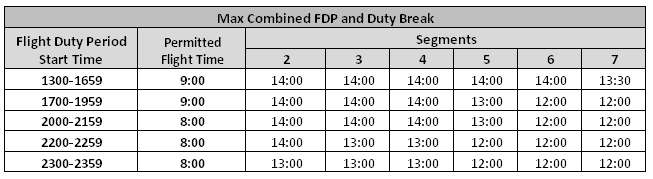
  1. Part 117 has Daily FDP limits governed under 117.13, however under 117.15 we have simplified the table to account for the application of the required duty break as well as the max permissible combined FDP and Duty Break.

split1

Table B (Modified)

  1. Part 121 does not actually have FDP limitations, instead a complicated system based upon 121.471(b) and (c):
    • A scheduled flight time in the 24 hours preceding the scheduled completion of a flight segment.
    • A required rest period in the 24 hours preceding the actual expected completion of a flight segment. The may be reduced due to operational contingencies before takeoff.
    • A compensatory rest period will be required following the release of a duty period that is preceded by a reduced rest period, this will effectively limit the duty period to a maximum of 16 or 15 hours dependent upon the scheduled flight time in the 24 hour period, and the compensatory rest period must commence within 24 hours of the start of the reduced rest period.

121.471(a)(b)

Objective comparisons of specific regulatory provisions:

split2

FAR 121 Subpart Q

(Max Skd FDP + Max Extension) – ((Max Flight Time – FT Buffer) + Brief + Min Break+ (Segments – 2) * Turn) = Allowed Delay within FDP

split3

Relative Efficiency of the FDP

100 * (Max Flight Time)/(Max Duty time – Debrief) + Allowed Delay within FDP)

split4

FAR 117 Split Duty

(Max Skd FDP + Max Extension) – ((Max Flight Time – FT Buffer) + Brief + Min Break+ (Segments – 2) * Turn) = Allowed Delay within FDP

(Max Skd FDP + Max Extension + Min Break) – ((Max Flight Time) + Brief + Min Break + (Segments – 2) * Turn) = Required Reduction of Flight Time

split5

split6

Relative FDP Efficiency

100 * (Max Flight Time- Required reduction of Flight Time)/(Max Skd FDP + Allowed Delay within FDP)

split7

Conclusions:

FAR 121 subpart Q is generally more efficient, however there are cases where FAR 117 will be more efficient, from 1300 to 1959 with less than 5 segments, and increase in efficiency of 1.54 percent over operation under 121 with less than 9 hours flight time in 24 hours, this is due to the higher flight time permitted under FAR 117.

FAR 121 overall allows for greater absorption of delays, however FAR 117 will permit absorption of delays with less than 4 segments, with permitted delays greater than or equal to 2 hours with 2 or 3 segments during the 2000 to 2259 FDP starts.

We also examined FDP’s under FAR 117 without applying the Split-Duty rules:

  1. Split duties were capable of absorbing delays with 3 and 4 segments by 0:30 more over non-split duties
  2. Efficiencies are less with split-duties than with non-split duties, this is primarily due to the longer Combined FDP’s with split duties.

An additional benefit to Split-Duties is that a FCM may be assigned 4 to 5 consecutive FDP’s that overlap the WOCL when each FDP has a min duty break of 2:00. Reference is FAR 117.27.

Recommendations:

The application of split duty under FAR 117, is best when the duties have 4 or fewer segments, and is best applied to FDP’s starting between 20:00 and 21:59, this allows for the highest average leg lengths.

Go back

Your message has been sent

Warning
Warning
Warning

Warning.

How maximum Flight Duty Periods and maximum Flight Times will affect Airlines FAR 121 subparts R and S versus FAR 117 – Augmented Flightcrews


By Garret Healy, Software Engineer, Jeppesen Inc.

Joshua Foltz, First Officer, Allegiant Air

Abstract:

The author’s developed the following tables as a crew planning tool. These tables demonstrate how strict FAR Part 117 work rules are in relation to allowed duty time when compared to FAR part 121 subpart R and S.

Airlines must schedule efficient Flight Duty Periods and carefully plan when Flight Duty Periods begin as well as how many segments are involved.

In order to schedule efficient pairings the Airlines should consider looking at productive hours (block time) versus non-productive hours (FDP time).

Since not all augmented operations involve acclimatization issues, we have also allowed for the ability to examine operations when the penalty for un-acclimated FDP may be applied.

Definitions:

Acclimated

means a condition in which a flightcrew member has been in a theater for 72 hours or has been given at least 36 consecutive hours free from duty.

Augmented flightcrew

means a flightcrew that has more than the minimum number of flightcrew members required by the airplane type certificate to operate the aircraft to allow a flightcrew member to be replaced by another qualified flightcrew member for in-flight rest.

Duty:

Is defined in FAR part 117.

Means any task that a flightcrew member performs as required by the certificate holder, including but not limited to flight duty period, flight duty, pre- and post-flight duties, administrative work, training, deadhead transportation, aircraft positioning on the ground, aircraft loading, and aircraft servicing.

Pre-Flight Duties:

Includes reporting for an assignment, acknowledging flights to be performed while on duty, will be operated in accordance to FAA regulations, including understanding of the expected conditions that will affect the flight(s) to be performed. Inspections of the aircraft for flight readiness, etc.

Flight Duty Period (FDP):

Is defined in FAR part 117.

Means a period that begins when a flightcrew member is required to report for duty with the intention of conducting a flight, a series of flights, or positioning or ferrying flights, and ends when the aircraft is parked after the last flight and there is no intention for further aircraft movement by the same flightcrew member. A flight duty period includes the duties performed by the flightcrew member on behalf of the certificate holder that occur before a flight segment or between flight segments without a required intervening rest period. Examples of tasks that are part of the flight duty period include deadhead transportation, training conducted in an aircraft or flight simulator, and airport/standby reserve, if the above tasks occur before a flight segment or between flight segments without an intervening required rest period.

Flight Time:

Is defined in FAR part 1.

Commences when an aircraft moves under its own power for the purpose of flight and ends when the aircraft comes to rest after landing.

Flightcrew Member (FCM):

Is defined in FAR part 1.

Is a pilot, flight engineer, or flight navigator assigned to duty in an aircraft during flight time.

Assumptions:

Brief time:

The amount of pre-flight duty before the flight departs the gate. Typically ranges between 0:45 to 1:00; generally contained within a CBA; for the purposes of this paper we will use 1:00.

Debrief time:

The amount of post-flight duty after the flight arrives at the gate. Typically ranges between 0:15 to 0:30; generally contained within a CBA; for the purposes of this paper we will use 0:15.

Flight Time Buffer:

The amount of time used to schedule a FCM within the permissible limitations of FAR part 117.11, for the purposes of this paper we will use 0:30.

Minimum Connect Time:

The minimum time from when an aircraft arrives at the gate, to the time when the aircraft moves away from the gate to allow for sufficient to unload/load passengers and baggage, and make any required service needs for the aircraft before departure as well as performance of pre-flight checklists, for the purposes of this paper we will use 0:45.

Permissible Extensions to FDP:

Under FAR 117.19, it is permissible to operate beyond the scheduled limitations in FAR 117.13 by 0:30, extensions up 2:00 may be conducted before departure under certain conditions, for the purposes of this paper we will use 0:30.

Cumulative Flight Time Limitations:

For the purposes of this paper, a FCM will not be exceeding any of the following limitations:

  1. Under 117.23, FCM’s are limited to 100 hours in 672 consecutive hours and 1000 hours in 365 calendar days.
  2. Under 121 subpart R and S, FCM’s are limited to 30 or 32 hours in 7 calendar days depending upon the type of operation, 100 / 120 hours in a calendar month / 30 calendar days and 1000 hours in a calendar year / 12 Calendar Months.

Cumulative Flight Duty Time Limitations:

For the purposes of this paper, a FCM will not be exceeding any of the following limitations:

  1. Under 117.23, FCM’s are limited to 60 hours in 168 consecutive hours and 190 hours in 672 consecutive hours.
  2. Under 121 subpart R and S, FCM’s are presently not limited by FDP time.

Rest Requirements:

For the purposes of this paper, a FCM will always be in compliance with the following requirements:

  1. Under 117.25, FCM’s are required to have been scheduled for and have been given a rest period of no less than 30 hours in the 168 consecutive hours preceding the start of a FDP.
  2. Under 121 subpart R and S, FCM’s are required to have been scheduled for and have been given a rest period of no less than 24 hours in the 7 calendar days preceding the scheduled completion of any flight subject to this subpart.

Flight segment count:

Under FAR 117, the maximum number of Flight segments that may be scheduled is 3 for Augmented operations.

FAA’s rational for the determination of FTL and FDP limits for Augmented Flightcrew:

With regards to FTL:

The FAA stated in the FNPRM that 13 hours for 3 pilot crews and 17 hours for 4 pilot crews would not impact safety.

With a 3 pilot crew the maximum flight deck duty time is 8:40 = (2/3)*13:00.

With a 4 pilot crew the maximum flight deck duty time is 8:30 = (2/4)*17:00.

Both of these values fall into the range for un-augmented operations of 8 to 9 hours.

With regards to FDP:

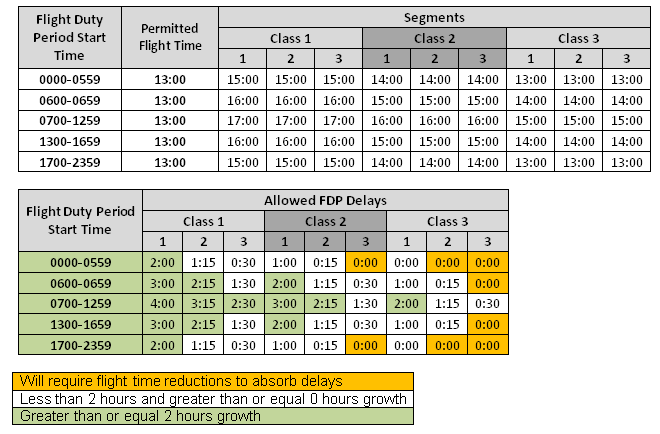
The FAA used the same diurnal concept used in un-augmented operations, basing the limitations on FDP start time. The FAA further refined the limitations on the number of pilots assigned to the FDP as well as the type of onboard rest facility. The limitations are presented in Table C.

Conceptual differences under FAR 117:

Under FAR 121 subpart Q, no credit is given to a FCM who is assigned to an augmented crew.

The only credit given to augmented operations for domestic operations is under FAR 121 subpart S, “Mainland Rules”.

Under FAR 121 subparts R and S, augmented operations had little details concerning onboard rest facilities, no limitations concerning the number of flight segments, and no specific onboard rest requirements for FCM apart from a differentiation of flight deck duty and time aloft as a FCM.

Under FAR 117, augmentation may take place under domestic or international operations; thus allow carriers additional flexibility.

Specific regulatory provisions applied:

Daily Flight Time Limitations (FTL):

Part 117 has Daily FTL’s governed under 117.11.

  1. Based upon the number of FCM’s assigned to a FDP, the limitation is either
    • 13:00 for 3 Pilots
    • 17:00 for 4 Pilots.
  2. Evaluated on a leg by leg basis, FCM may not continue a flight if before takeoff it is known that the FTL will be violated.

Part 121 has Daily FTL’s governed under FAR 121 subpart S

  1. Subpart S is broken up into two distinct sections
    • “Main Land” operations solely within the 48 States
    • “International” operations that include stations outside the 48 states.
  2. Mainland Rules:
    • Under 121.505(a), a 2 pilot crew may not be scheduled for more than 8:00, this limitation sets a base line used in the establishment further limitations under this subpart.
    • Under 121.507(a)(2), a 3 pilot crew may not be scheduled for more than 12:00.
    • Under 121.509(a)(2), a 4 pilot crew may not be scheduled for more than 16:00.
  3. International Rules:
    • Under 121.521(a), a 3 pilot crew may not be scheduled for more than 12:00.
    • Under 121.523(b), a 4 pilot crew is required to have adequate rest periods on the ground while away from base, although no specific FTL is specified, it has regularly been interpreted as 16:00.
  4. Part 121 has Daily FTL’s governed under FAR 121 subpart R.
    • Under 121.481(a) and (b), a 2 pilot crew may not be scheduled for more than 8:00, this limitations sets a base line used in the establishment further limitations under this subpart.
    • Under 121.483(a), a 3 pilot crew may not be scheduled for more than 12:00.
    • Under 121.485(a), a 4 pilot crew is required to have adequate rest periods on the ground while away from base, although no specific FTL is specified, it has regularly been interpreted as 16:00.

Daily FDP Limitations:

Part 117 has Daily FTL’s governed under 117.17.

  1. Based upon FDP start time, The number of FCM assigned and the class of the onboard rest facility; the scheduled limitation is defined in Table C.
  2. Extensions to the assigned FDP are permitted in accordance with 117.19.

 table c

Table C

 Part 121 does not actually have FDP limitations, instead duty time limitations will be used:

  1. FAR 121 subpart S “Mainland Rules”:
    • 2 Pilots – 16:00 Duty Limit
    • 3 Pilots – 18:00 Duty Limit
    • 4 Pilots – 20:00 Duty Limit
  2. FAR 121 subpart S “International Rules” and FAR 121 subpart R:
    • These sections do not actually establish duty limits, but best practices and many contractual limitations will establish duty limits like those for the “Mainland Rules”.
    • For the purposes of our research, we will apply these methods as well.

Objective comparisons of specific regulatory provisions:

garret9

Some operations will be performed while a FCM is in an unacclimated state, in those cases a 0:30 penalty to the FDP must be assessed under FAR part 117.

FAR 121 Subpart S “Mainland Rules”

(Max Duty Time – Max Extension) – ((Max Flight Time – Flt buffer) + Brief + Debrief + (Segments – 1) * Turn) = Allowed Flight Duty Period delay

garret1

Relative Efficiency of the FDP

100 * (Max Flight Time)/((max duty time – debrief) + Permitted Pairing Growth) * (2/Flightcrew size)

garret2

FAR 117 – 3 Pilots

((Max Skd FDP – Unacclimated Penalty)+ Max Extension) – ((Max Flight Time – FT Buffer) + Brief + (Segments – 1) * Turn) = Allowed Flight Duty Period delay

garret3

((Max Skd FDP- Unacclimated Penalty) + Max Extension) – ((Max Flight Time) + Brief + (Segments – 1) * Turn) = Required Reduction of Flight Time

garret4

Relative FDP Efficiency

100 * (Max Flight Time- Required reduction of Flight Time)/((max skd FDP – unacclimated penalty) + Permitted Pairing Growth) * (2/3)

garret5

FAR 117 – 4 Pilots

((Max Skd FDP – Unacclimated Penalty)+ Max Extension) – ((Max Flight Time – FT Buffer) + Brief + (Segments – 1) * Turn) = Allowed Flight Duty Period delay

garret6

((Max Skd FDP- Unacclimated Penalty) + Max Extension) – ((Max Flight Time) + Brief + (Segments – 1) * Turn) = Required Reduction of Flight Time

garret7

Relative FDP Efficiency

100 * (Max Flight Time- Required reduction of Flight Time)/((max skd FDP – unacclimated penalty) + Permitted Pairing Growth) * (2/4)

garret8

Conclusions:

FAR 117 when compared to FAR part 121 subparts R and S augmented operations, overall the pairings will be more efficient; this is primarily due to the fact that flight deck time has increased by 30 to 40 minutes.

Like part 121 operations, 3 pilot operations under part 117 will be more efficient compared to 4 pilot operations. We also see that the ability to accept delays with an increase in the number of segments decreases under both part 121 and part 117.

While part 117 has different limitations based upon the class of the onboard rest facility that will reduce the permissible FDP limitations, this seems to increase the efficiency across both 3 and 4 pilot.

FDP’s that start between 0700 and 1259 have the best ability to accept delays “the sweet spot”, while those between 1700 and 0559 are more prone to the negative effects associated with delays.

FDP’s that use a class 1 rest facility have the best ability to accept delays, while class 3 have the worst ability, due to the diminished FDP limitations.

We also examined longer brief/debrief/turn times, to emulate different contractual requirements to account for the clearing of customs and immigration, which equally diminished FAR 117 and FAR 121 operations.

Increased turn times are also to be expected with larger aircraft and higher passenger capacities, but it is still felt that the formulas used are valid and properly present the concepts.

Lastly we looked at the application of the unacclimated penalty, as this factor will only apply to part 117, it should diminish efficiency by approx. 1.08 percent, and reduce the ability to accept delays by 0:30.

Recommendations:

The authors’ recommend that augmented FDP’s be scheduled for 1 or 2 segments especially when using a class 3 rest facility to prevent disruptions due to delays, apply realistic buffers for connections times to help mitigate delays.

How maximum Flight Duty Periods and maximum Flight Times will affect Airlines FAR 121 subparts R and S versus FAR 117 – Augmented Flightcrews

Go back

Your message has been sent

Warning
Warning
Warning

Warning.


How maximum Flight Duty Periods and maximum Flight Times will affect Airlines – FAR 121 subpart Q versus FAR 117 – un-augmented


By Joshua Foltz, First Officer, Allegiant Air

Garret Healy, Software Engineer, Jeppesen Inc.

Abstract:

The author’s developed the following tables as a crew planning tool. These tables demonstrate how strict FAR Part 117 work rules are in relation to allowed duty time when compared to FAR part 121 subpart Q.

Airlines must schedule efficient Flight Duty Periods and carefully plan when Flight Duty Periods begin as well as how many segments are involved.

In order to schedule efficient pairings the Airlines should consider looking at productive hours (block time) versus non-productive hours (FDP time).

Definitions:

Duty:

Is defined in FAR part 117.

Means any task that a flightcrew member performs as required by the certificate holder, including but not limited to flight duty period, flight duty, pre- and post-flight duties, administrative work, training, deadhead transportation, aircraft positioning on the ground, aircraft loading, and aircraft servicing.

Pre-Flight Duties:

Includes reporting for an assignment, acknowledging flights to be performed while on duty, will be operated in accordance to FAA regulations, including understanding of the expected conditions that will affect the flight(s) to be performed. Inspections of the aircraft for flight readiness, etc.

Flight Duty Period (FDP):

Is defined in FAR part 117.

Means a period that begins when a flightcrew member is required to report for duty with the intention of conducting a flight, a series of flights, or positioning or ferrying flights, and ends when the aircraft is parked after the last flight and there is no intention for further aircraft movement by the same flightcrew member. A flight duty period includes the duties performed by the flightcrew member on behalf of the certificate holder that occur before a flight segment or between flight segments without a required intervening rest period. Examples of tasks that are part of the flight duty period include deadhead transportation, training conducted in an aircraft or flight simulator, and airport/standby reserve, if the above tasks occur before a flight segment or between flight segments without an intervening required rest period.

Flight Time:

Is defined in FAR part 1.

Commences when an aircraft moves under its own power for the purpose of flight and ends when the aircraft comes to rest after landing.

Flightcrew Member (FCM):

Is defined in FAR part 1.

Is a pilot, flight engineer, or flight navigator assigned to duty in an aircraft during flight time.

Assumptions:

Brief time:

The amount of pre-flight duty before the flight departs the gate. Typically ranges between 0:45 to 1:00; generally contained within a CBA; for the purposes of this paper we will use 1:00.

Debrief time:

The amount of post-flight duty after the flight arrives at the gate. Typically ranges between 0:15 to 0:30; generally contained within a CBA; for the purposes of this paper we will use 0:15.

Flight Time Buffer:

The amount of time used to schedule a FCM within the permissible limitations of FAR part 117.11, for the purposes of this paper we will use 0:30.

Minimum Connect Time:

The minimum time from when an aircraft arrives at the gate, to the time when the aircraft moves away from the gate to allow for sufficient to unload/load passengers and baggage, and make any required service needs for the aircraft before departure as well as performance of pre-flight checklists, for the purposes of this paper we will use 0:45.

Permissible Extensions to FDP:

Under FAR 117.19, it is permissible to operate beyond the scheduled limitations in FAR 117.13 by 0:30, extensions up 2:00 may be conducted before departure under certain conditions, for the purposes of this paper we will use 0:30.

Cumulative Flight Time Limitations:

For the purposes of this paper, a FCM will not be exceeding any of the following limitations:

1        Under 117.23, FCM’s are limited to 100 hours in 672 consecutive hours and 1000 hours in 365 calendar days.

2        Under 121 subpart Q, FCM’s are limited to 30 hours in 7 calendar days, 100 hours in a calendar months and 1000 hours in a calendar year.

Cumulative Flight Duty Time Limitations:

For the purposes of this paper, a FCM will not be exceeding any of the following limitations:

1        Under 117.23, FCM’s are limited to 60 hours in 168 consecutive hours and 190 hours in 672 consecutive hours.

2        Under 121 subpart Q, FCM’s are presently not limited by FDP time.

Rest Requirements:

For the purposes of this paper, a FCM will always be in compliance with the following requirements:

1        Under 117.25, FCM’s are required to have been scheduled for and have been given a rest period of no less than 30 hours in the 168 consecutive hours preceding the start of a FDP.

2        Under 121 subpart Q, FCM’s are required to have been scheduled for and have been given a rest period of no less than 24 hours in the 7 calendar days preceding the scheduled completion of any flight subject to this subpart.

Specific regulatory provisions applied:

Daily Flight Time Limitations (FTL):

1        Part 117 has Daily FTL’s governed under 117.11.

  • Based upon FDP start time, the limitation is either 8:00 or 9:00 as defined in Table A.
  • Evaluated on a leg by leg basis, FCM may not continue a flight if before takeoff it is known that the FTL will be violated.

table A

Table A


      2        Part 121 has Daily FTL’s governed under 121.471(a)(4).

  • The scheduled limitation is 8:00.
  • A FCM may continue the assigned FDP as long as the flight itinerary is the same as what the FCM began with no further constraints (legal to start, legal to finish), else a reevaluation at the point of rescheduling must take place.


Daily FDP Limitations:

1        Part 117 has Daily FTL’s governed under 117.13.

  • Based upon FDP start time, the scheduled limitation is defined in Table B.
  • Extensions to the assigned FDP are permitted in accordance with 117.19.

 table b

Table B


      2        Part 121 does not actually have FDP limitations, instead a complicated system based upon 121.471(b) and (c):

  • A scheduled flight time in the 24 hours preceding the scheduled completion of a flight segment.
  • A required rest period in the 24 hours preceding the actual expected completion of a flight segment. The may be reduced due to operational contingencies before takeoff.
  • A compensatory rest period will be required following the release of a duty period that is preceded by a reduced rest period, this will effectively limit the duty period to a maximum of 16 or 15 hours dependent upon the scheduled flight time in the 24 hour period, and the compensatory rest period must commence within 24 hours of the start of the reduced rest period.

121.471(a)(b)

Objective comparisons of specific regulatory provisions:

josh6

FAR 121 Subpart Q

(Max Duty Time – Max Extension) – ((Max Flight Time – Flt buffer) + Brief + Debrief + (Segments – 1) * Turn) = Allowed Flight Duty Period delay

josh1

Relative Efficiency of the FDP

100 * (Max Flight Time)/((max duty time – debrief) + Permitted Pairing Growth)

josh2

FAR 117

(Max Skd FDP + Max Extension) – ((Max Flight Time – FT Buffer) + Brief + (Segments – 1) * Turn) = Allowed Flight Duty Period delay

josh3

(Max Skd FDP + Max Extension) – ((Max Flight Time) + Brief + (Segments – 1) * Turn) = Required Reduction of Flight Time

josh4

Relative FDP Efficiency

100 * (Max Flight Time- Required reduction of Flight Time)/(max skd FDP + Permitted Pairing Growth)

josh5

Conclusions:

FAR 117 when compared to FAR part 121 subpart Q, overall the pairings will have less productivity; however, a concentration of FDP starts from 0500 to 1650 with 5 segments will produce an increase in efficiency of 2.76 percent, a secondary window with 3 or 4 segments from 17:00 to 04:59, with a 0.98 increase. The increase in efficiency in the first window is primarily the result of the decrease in permitted FDP time due to the increase in the number of flight segments, while the increase in the second window is primarily due to the decrease in permitted FDP as a result of the diurnal component.

FAR 117 will have two “Sweet Spots” to absorb delays, the first between 07:00 to 12:59, and the second between 20:00 and 21:59.

FAR 117 through all time frames will require flight time reduction to allow for the ability to absorb delays when FCM are scheduled for six (6) or more flight segments.

Recommendations:

The authors’ recommend that airline management agree upon a specific company “buffer time” between maximum scheduled flight time from maximum allowed FAA flight time. For example, perhaps airlines could clarify a 20 minute buffer from maximum FAA flight time. For example, the company maximum flight time could be 7:40 or 8:40 scheduled flight time depending on what time the flight crew member starts. This “buffer time” may be higher in the winter time than the summer time. Perhaps actual data can be collected from past months of flying to agree upon a conservative but logic buffer time. In the real world extensions are an option to complete the pairing.

how-maximum-flight-duty-periods-and-maximum-flight-times-will-affect-airlines

Go back

Your message has been sent

Warning
Warning
Warning
Warning

Warning.

FAA – FRMS Updated Documentation


120-103A – Fatigue Risk Management Systems for Aviation Safety

Date Issued
May 06, 2013
Responsible Office
AFS-220
Description


(1) Describes the basic concepts of Fatigue Risk Management Systems (FRMS), as prescribed in Title 14 of the Code of Federal Regulations (14 CFR) part 117, § 117.7, and how they relate to aviation industry employees safely performing their duties.

(2) Provides information on the components of an FRMS as applied to aviation, and on how to implement an FRMS within an aviation operation.

(3) Defines an FRMS as an operator-specific process; therefore, while all FRMSs will have common elements, the specifics will be tailored to a certificate holder’s particular conditions.

(4) Provides (in Appendix 2, Fatigue Risk Management System Development) the certificate holder with the necessary detailed guidance to prepare for the FRMS approval process, develop the required documentation, develop and apply fatigue risk management (FRM) and Safety Assurance (SA) processes, collect and analyze data, develop flightcrew FRMS operations procedures and a step-by-step process required for Federal Aviation Administration (FAA) evaluation and validation of the proposed FRMS application.

AC_120-103A

Acclimatization – Differences in Regulatory Schemes


Questions concerning Acclimatization deemed it necessary to compare Sleep science, FAR 117 and other regulatory schemes.

Acclimatization – Differences in Regulatory Schemes

Re-Scheduling FDP start time


I added guidance for re-scheduling FDP start times in accordance with the FAA letters of clarification from 05-Mar-2013.

Understanding FAR Part 117 v 1.7

I also updated the powerpoint presentation to include the same information.

FAA Flight Crewmember Duty and Rest Requirements FNPRM v1.13